|
|
 |
|
||||||
|
About the Cold War Museum or visit
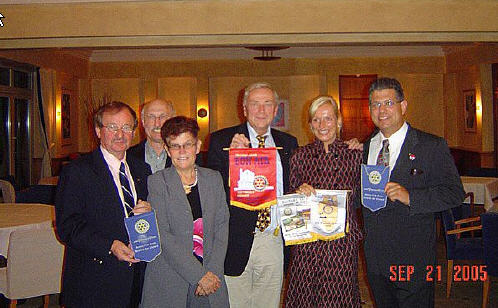
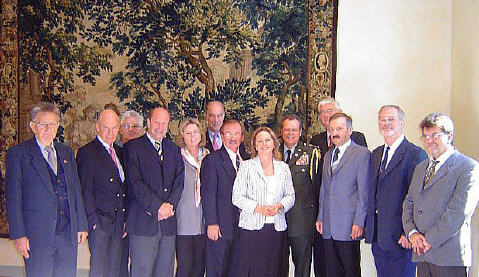
On the evening of September 20, we attended the Berlin “Bridge of Unity” Rotary meeting near Potsdam. “Bridge of Unity” refers to the well-known Glienicker Bridge used in the 1962 Spy exchange of Francis Gary Powers, Sr. for KGB Colonel Rudolf Abel.
(Photo) Cold War Museum Representatives Werner Juretzko, Baerbel Simon, and Francis GaryPowers, Jr. pose with members of the “Bridge of Unity” Berlin Rotary club near Potsdam, Germany.
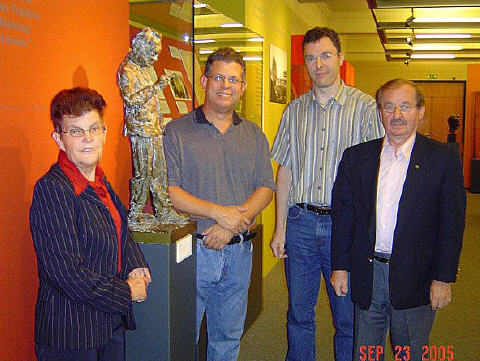
We also had the opportunity to visit the Willy Brandt exhibition in the city hall and meet the Director, Dr. Wolfram Hoppenstedt, who gave a private tour with expert explanations (www.willy-brandt.com). (Photo) CWM German Liaison, Baerbel Simon; Francis Gary Powers, Jr.; Director of the Willy Brandt Museum, Dr. Wolfran Hoppenstedt; and Werner Juretzko at the Willy Brandt expo at the Schoeneberger Rathaus in September. This is the place were President Kennedy told demonstratively to the world: “Ich bin ein Berliner”
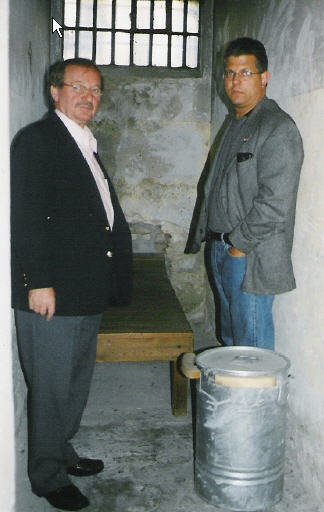
Then we went to the memorial site of Hohenschoenhausen, the former Stasi prison and interrogation center of the state security of the GDR. We had a short reception with the memorial site management. Our Midwest Chapter organizer and well-informed guide, Werner Juretzko, was incarcerated there in the 1950s. Werner happened to be in Berlin at the same time and told us of his memories while standing in his former cell. This site still has something depressing even after many years. It is difficult to believe what people did against people who did not accept the regime. They were tormented, interrogated, or condemned to long imprisonment or death. They disappeared to Bautzen, Hoheneck, Brandenburg and other places, in special camps and prisons www.stiftung-hsh.de
(Photo) Midwest Chapter Executive Director, Werner I. Juretzko and Francis Gary Powers, Jr. pose in the “ICE Cell” in Hoschenhousen where Werner spent 6 years as a political prisoner during the 50’s. A highlight during the Berlin visit was to walk thru and stay in some of the underground KGB/ Stasi interrogations prison cells. It was the final stay for over 46 western agents who were marched off to the guillotine from here. That is according to Werner who recounts the time he spends here in 1955 as a political prisoner.
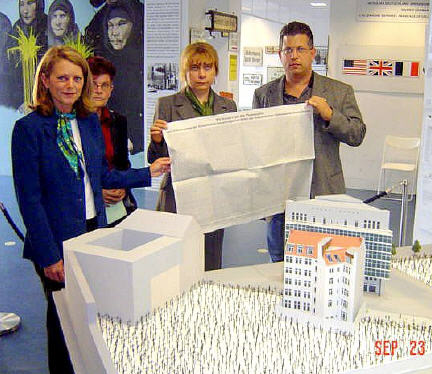
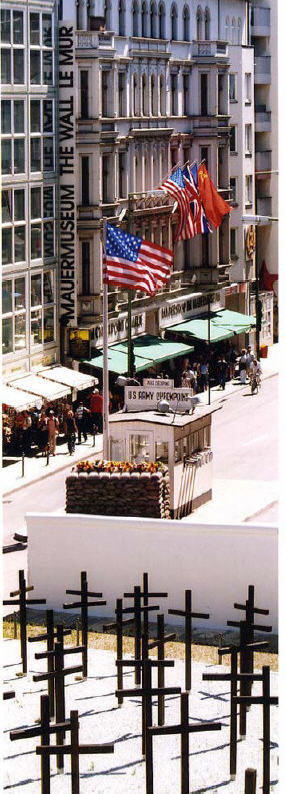
Today everyone feels at home at Checkpoint Charlie. People are at a place of which they are proud. People engage themselves for a history that they regard as their own history. The Americans, British, and French remember the time when they were responsible for Berlin’s freedom here. The citizens of East European countries think of the end of the Wall when they think of Checkpoint Charlie, and of the end of the Iron Curtain, and of the sacrifices made in fighting for freedom. People who still live in divided countries today - in Israel, Palestine, North and South Korea, Ireland, Cyprus - dream of a peaceful co-existence. For all of them, Checkpoint Charlie is a place of freedom and a place where world history is manifested. On the anniversary of the fall of the Berlin Wall on November 09, 1989, we want to commemorate the 1065 victims of the GDR border regime and the Socialist Unity Party of Germany, the SED, to whom we owe today's freedom in unity.
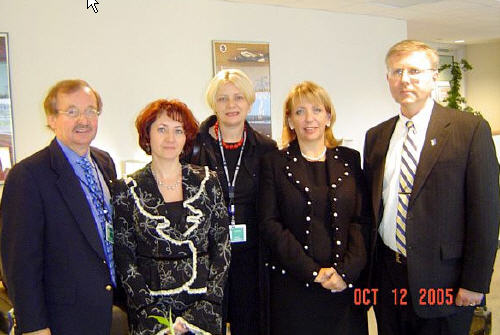
(Photo) Colorado NBC News Correspondent,Leanne Gregg; Cold War Museum GermanLiaison, Baerbel Simon; Checkpoint CharlieMuseum Director, Alexandra Hildebrandt; andFrancis Gary Powers, Jr. discuss issues ofmutual interest at the Checkpoint Charlie Museum in September.
With the Wall Museum, the Museum Haus am Checkpoint Charlie and the museum of the global non-violent struggle for human rights, Dr. Hildebrandt protested against the recognition and acceptance of given realities - against the violation of human rights in all of Eastern Europe for 42 years! Here at Checkpoint Charlie is where the division of both worlds started and ended. Here is where a border was opened 15 years ago, which not only divided Germany into two separate states, but also the European people into an eastern and a western hemisphere. There is no other place in the world where the division between east and west was more apparent than here at Checkpoint Charlie. Here is where a wall divided an entire city. Here is where the people of the United States of America effectively vowed to stand up for basic rights like human rights, democracy, and freedom. Many heads of state visited Checkpoint Charlie over 28 years and gave rise to the hopes of the people for freedom and peace. Here is where Ronald Reagan decided to change reality and tear down the "Iron Curtain".
WHISKY-VODKA-LINE September 17, 2005 marked the 60th anniversary of the Wanfried agreement, also referred to as the Whisky-Vodka -Line agreement, signed between the United States and the Union of Socialist Soviet Republics at the end of WWII. This agreement followed the Potsdam Agreement and centered on 2.7 miles of rail line track, which connected the American enclave of Bremerhaven with the American zone of occupation located in the southwest of Germany. The 2.7 miles of railroad track ran thru Russian occupied territory, which led, immediately to friction in the early days of the Cold War. To commemorate the event, our Midwest Chapter Executive Director, Werner I. Juretzko was the main speaker at an event that took place at the original site at the Kalkhof Estate at Wanfried located in the Fulda Gap. The United States was represented by Donald H Zedler, Defense attach, US Embassy and LTC Darryl A. Owens, Director, DPTMS, Directorate of Plans, Training, Mobilization and Security. Russia was represented thru the 1st Secretary, Consulate ofRussia, Leipzig. This German MDR history channel will air a 90 Minutes special about this event on December 28, 2005. For more information, visit www.coldwarhistory.us/Cold_War/The_Whisky-Vodka-Line/the_whisky-vodka-line.html
(Photo) Pictured are the following individuals in the actual room where theWhiskey Vodka Line Agreement was signed. From L to R - Richard Baier, eventeye witness, Harald von Scharfenberg, Andreas von Scharfenberg, Valeska von Hagen and Ilse von Scharfenberg, descendants of the Kalkhof estate, Werner I. Juretzko, Cold War Museum Midwest Chapter, Col. Donald H. Zedle . Defense Attach US Embassy, Mayor of Wanfried Otto Frank and Wolfgang Ruske, Wilfried Wegener, and Viktor Speiser all from the Iron Curtain Border Museum Schifflersgrund.
UKRAINE’S FIRST LADY MEETS WITH MIDWEST CHAPTER REP IN CHICAGO
(Photo) After a visit to the United States, Madame Yuschenko is homebound from Chicago's O’Hare International Airport. She is receiving her official send off by Chicago airport officials Mrs. Nellie Stefanski, Assistant to the Commissioner O'Hare International Airport and Airport Ambassador Werner I. Juretzko. Standing next to her is Consul Oleh Shevchenko, Consulate General of Ukraine in Chicago. Pictured next to Werner I. Juretzko, who is the Cold War Museum - Midwest Chapter Executive Director, is Vice Consul Olena Dzhelmach, also from the Consulate General of the Ukraine. Together they spent some pleasant recollections of Madam Yuschenko's visit in the States before boarding the plane.
|
|
|
|
|
|
|
[Coldwarhistory-W.I.Juretzko] [Biography] [Profile] [History] [Cold War] [Articles] [Publications] [Photos] [Exhibitions] [Links] |
|
|
 |